Residential properties in Middle Tennessee face prolonged parasite activity driven by humid subtropical climate patterns extending from April through late October. A targeted outdoor perimeter barrier serves properties…
Residential properties in Middle Tennessee face prolonged parasite activity driven by humid subtropical climate patterns extending from April through late October. gov/departments/parks/greenways">Shelby Bottoms Greenway. Fleas and ticks seek sheltered microclimates beneath broadleaf shrubs, ivy patches, and unraked organic matter where relative humidity stays above 70 percent.
When left untreated, wildlife hosts such as white-tailed deer, raccoons, and feral rodents drop gravid female ticks and flea pupae directly into active recreation zones.
The barrier program applies microencapsulated liquid pyrethroids paired with synthetic insect growth regulators (IGRs) like pyriproxyfen to disrupt chitin synthesis and juvenile hormone production. html">Tennessee Department of Agriculture regulatory division.
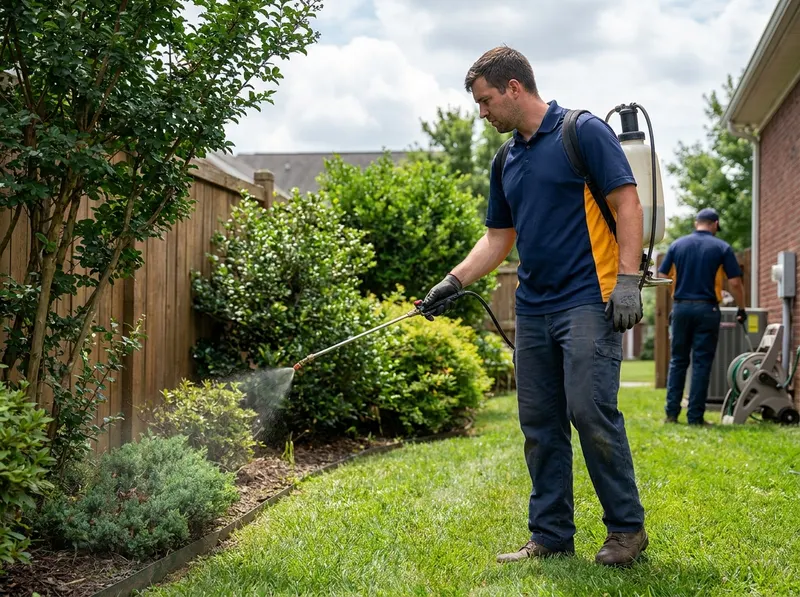
Spray bands extend 3 feet up the exterior foundation and 5 to 10 feet outward onto ground surfaces, establishing a continuous structural boundary. Granular formulations, applied with calibrated rotary spreaders, target dense turf matrices and ornamental bed lines to penetrate beneath the thatch layer.
Property structural layouts across Davidson County influence application mechanics.
Historic lots in 12 South, Belmont-Hillsboro, and Germantown often feature compact, shaded rear yards with mature tree canopies and creeping ground covers that shield flea larvae from sunlight desiccation. In suburban acreages found across Green Hills or older parcels along Donelson and Inglewood, tall fescue grasses and deep perimeter brush lines require high-volume broadcast dispersion to coat leaf litter where lone star ticks ambush passing hosts. In high-density developments across The Nations, East Nashville, and Sylvan Park, zero-lot-line configurations require targeted perimeter treatments to prevent cross-infestation from adjacent unmanaged lots without overspraying onto neighboring hardscapes.
The tactical treatment workflow proceeds across three discrete operational stages: 1. Technicians complete an initial perimeter inspection to map shade corridors, dog runs, deck undersides, and leaf litter accumulation zones. 2.
Field personnel apply low-pressure directional sprayers along structural perimeters and broadcast granular growth regulators across turf surfaces to halt nymph development. 3. Residents keep children and pets off treated areas until surfaces dry completely, which requires approximately 60 to 90 minutes depending on ambient temperature and wind speed.
Homeowners can reach HarborFlare Insect Defense at (615) 537-0362 to verify application boundaries.
Every job gets a firm, written price after a free on-site visit.
For standards, safe disposal, and service guidance on pest control services in Nashville, TN, useful references include U.S. EPA, ENERGY STAR, U.S. Dept. of Energy, Consumer.gov, U.S. Census Bureau, and Google Maps. General consumer and small-business resources are available from USA.gov, Better Business Bureau, FTC Consumer Advice, U.S. Small Business Administration, and Ready.gov.
Tell us about your flea and tick yard shield job in Nashville and we'll send a clear, written quote, usually the same day.
 HarborFlare Insect Defense